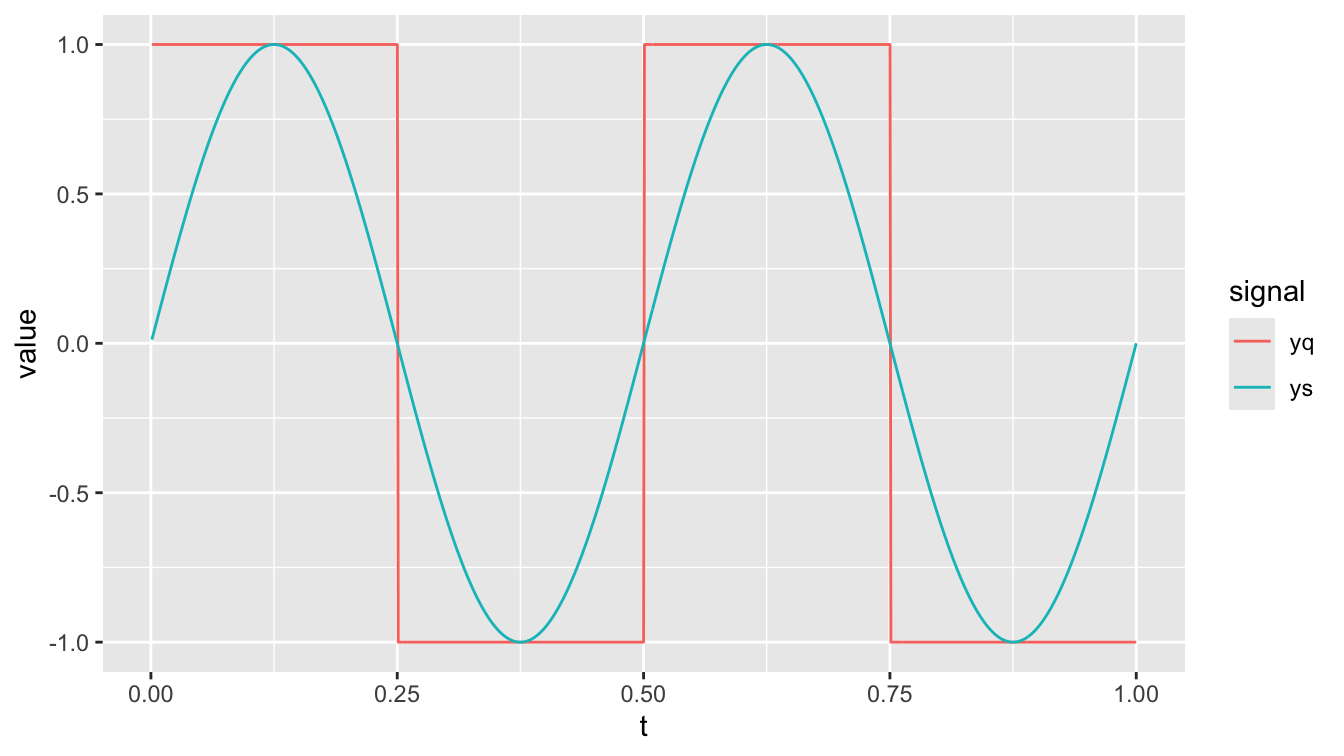
# FUNZIONE: Generazione segnale sinusoidale con diverse armoniche
signal <- function(t, pars, rad = FALSE) {
  stopifnot(is.data.frame(pars))
  with(pars, {
    if (!rad) {
      phi <- phi/180*pi
      f <- 2*pi*f
    }
    map_dbl(t, \(t) sum( map_vec(seq_along(w) , \(i) w[i]*sin(t*f[i] + phi[i] ))))
  })
}

# Parametri fondamentali
f0 <- 2
fc <- 1000
Tm <- 1
dt <- 1/fc

# Parametri dei segnali
pars_1 <- tibble(
  w = c(1, 0.5, 0.3), f = c(f0, 2*f0, 4*f0), phi = c(0, 0, 0))
pars_2 <- tibble(
  w = c(1, 0.5, 0.3), f = c(15*f0, 20*f0, 25*f0), phi = c(0, 10, 20))

# Generiamo i segnali ed i loro spettri:
Segnali <- tibble(
  t = seq(dt, Tm, dt),
  y1 = signal(t, pars_1),
  y2 = signal(t, pars_2),
  f = 0:(length(t)-1)/max(t),
  fft1 = fft(y1),
  intensity1 = Mod(fft1) / length(t)*2,
  phase1 = Arg(fft1)/pi*180,
  fft2 = fft(y2),
  intensity2 = Mod(fft2) / length(t)*2,
  phase2 = Arg(fft2)/pi*180
)

# Grafico a barre con plot_ly:
pp <- plot_ly() %>%
  add_lines(data = Segnali, x = ~f, y = ~intensity1, type = "bar", name = "Segnale 1", marker = list(color= "blue")) %>%
  add_lines(data = Segnali, x = ~f, y = ~intensity2, type = "bar", name = "Segnale 2", marker = list(color= "cyan")) %>%
  layout(
    title = "Spettri dei due Segnali",
    xaxis = list(title = "Frequenza [Hz]")
  )
pp
A marker object has been specified, but markers is not in the mode
Adding markers to the mode...
A marker object has been specified, but markers is not in the mode
Adding markers to the mode...